


Sand Filters
Ver más Sand Filters
Swimming pool filter Neptuno 300
Choose your option

Neptuno 400 swimming pool filter filter system
Choose your option

Choose your option

Choose your option

Swimming pool filter Neptuno 500
Choose your option

Alaska 500 swimming pool filter
Choose your option
Filtration packs
Ver más Filtration packs
Filtration Pack Star Plus 500 + Nox 75 15M
Choose your option

Pack filtration Star Plus 500 + Nox 75 15M + Glass
Choose your option

Filtration Pack Star Plus 600 + Nox 100 18M
Choose your option
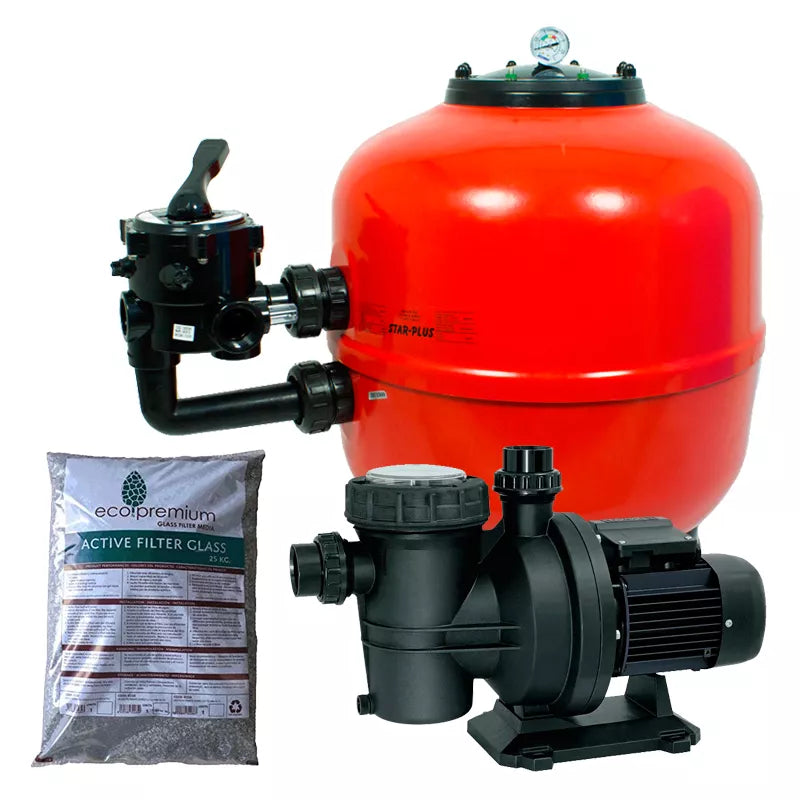
Pack filtration Star Plus 600 + Nox 100 18M + Glass
Choose your option

Skypool 500 filtration pack + Aquasphere SSP 75M
Choose your option

Skypool 500 filtration pack + Aquasphere SSP 75M + Glass
Choose your option
Cartridge Filters
Ver más Cartridge Filters
Cartridge filter Astralpool ClariSave 10
Choose your option

Cartridge filter Astralpool ClariSave 15
Choose your option

Cartridge filter Astralpool ClariSave 20
Choose your option

Cartridge filter Astralpool ClariSave 25
Choose your option

Filter cartridge Astralpool ClariSave 10
Choose your option

Filter cartridge Astralpool ClariSave 15
Choose your option
Monoblock swimming pool filters

Monobloc filter d. 320 mm with pump 0.24 HP
Choose your option

ESPA Neat 350 monobloc filter with pump Nox 25
Choose your option

ESPA Neat 450 monobloc filter with pump Nox 33
Choose your option


Questions and answers
What type of filter should I choose: sand, cartridge, or monoblock?
The choice depends on the size and type of pool:
- Sand filter: the default option for in-ground family pools (50–150 m³). It is the best-selling type, offering the best performance-to-cost ratio, universal replacement parts, and simple operation.
- Cartridge filter: only if you have specific constraints: limited space in the equipment room, water supply issues, a small pool (up to 30 m³), or a spa.
- Monoblock filter: for small-to-medium family pools (up to 40 m³), especially above-ground, elevated, or quick-install pools where simplifying the equipment room is a priority.
- Filtration package: when you want to buy a pre-matched filter + pump + media without having to size components separately.
For 90% of in-ground family pools, the right choice is a 500–600 mm sand filter with a 6-way valve, from any of the five brands in the catalog based on your brand preference and budget.
Which brand of filter is best for my pool?
All five brands in the catalog have their place. Make a quick decision based on your priorities:
- Price plus content with proven quality → Coral or Productos QP (shared platform, cross-compatible parts)
- Broader catalog with all sizes and ranges → Astralpool (10 sub-lines, residential and semi-industrial)
- Better coverage with top valve (TOP) for narrow machine rooms → Hayward
- Compatibility with existing pump or integrated filter+pump (monoblock) → ESPA
For standard family pools (50–90 m³), the four top-selling models in the catalog cover all bases:
- Coral Neptuno/Ciclón 500 (€305): the budget option
- Coral Alaska/Red 600 (€389): the balanced choice
- Astralpool Star Plus 600 (€369): the Fluidra alternative
- ESPA FKP 620 (€329): the Catalan option
What size filter do I need based on the volume of my pool?
The general rule: the filter should circulate the entire volume of the pool every 4–6 hours. Recommended flow rate = Volume / 4. Reference table:
- Up to 25 m³: 300–400 mm filter + 0.25–0.33 HP pump
- 25–50 m³: 400–500 mm filter + 0.5–0.75 HP pump
- 50–80 m³: 500–600 mm filter + 0.75–1 HP pump (most common range for family pools)
- 80–120 m³: 600–760 mm filter + 1–1.5 HP pump
- 120–180 m³: 760–900 mm filter + 1.5–2 HP pump
- 180+ m³: 900–1,050 mm filter + 2–3 HP pump
In warm regions (Andalusia, Levante, Balearic Islands) with long swimming seasons, high swimmer traffic (large families, vacation rentals), or pools with slat/roller covers, move up one step on the guideline table.
For questions regarding specific cases, contact technical support or use the contact form.
Is sand or filter glass a better filter medium?
Direct comparison:
- Silica sand: economical and standard option. Filters 25–40 microns. Service life: 5–7 years. Price: €2–5/kg.
- Filter glass (recycled): premium option. Filters 15–25 microns (finer). Service life: 8–12 years (almost twice as long). Does not compact over time. Price: €4–8/kg.
General recommendation:
- For pools with a salt chlorinator: filter glass (better resists continuous chemical attack)
- For pools on a tight budget: standard sand (the extra cost of glass pays off only in the long term)
- For high-use pools: glass (better water quality, less maintenance)
Important: if you switch from sand to glass, use approximately 80% of the weight of the equivalent sand (glass has a lower density). See the full catalog of filter media and more details in the filter media comparison on the blog.
How often should the filter be backwashed?
The general rule of thumb is the pressure gauge reading: when the pressure rises 0.5 bar above normal pressure (with a freshly cleaned filter), it’s time to backwash.
Approximate frequency for a family pool with normal use:
- Peak season: every 1–2 weeks
- Areas with fewer swimmers: every 3–4 weeks
- After a storm or heavy use: when the pressure gauge rises, without waiting for the scheduled time
Correct procedure:
- Turn off the pump
- Set the valve to "Backwash, " run the pump for 2–3 minutes until the water in the sight glass runs clear
- Stop the pump, switch to "Rinse, " run for 30–40 seconds
- Stop the pump, return to "Filter" and resume normal operation
Don’t overdo it: Backwashing too frequently (every 2–3 days) wears out the valve seal prematurely and wastes a lot of water unnecessarily.
When is it better to replace the entire filter instead of using replacement cartridges?
Rule of thumb: if the total cost of replacement parts plus labor exceeds 60–70% of the price of an equivalent new filter, it’s usually more cost-effective to replace the entire filter.
Cases where it is ALWAYS worth repairing (costing €5–50):
- Replacing the lid gasket
- Replacing the pressure gauge
- Replacing the drain valve
- Replacement of spent sand/glass
Cases where it is RARELY worth repairing:
- Cracked polyesterbody (large crack): requires a new filter
- Need to replace several major components simultaneously + strainers + filter media
- Discontinued model with no specific replacement parts available
With proper maintenance (backwashing, timely replacement of gaskets, protection from the sun), a Coral/Astralpool/Hayward/QP/ESPA filter can last 15–25 years. To view available replacement parts, see pool filter replacement parts.
Are filters suitable for pools with a salt chlorinator?
Yes, absolutely. All the brands in the catalog (Coral, Astralpool, QP, Hayward, ESPA) are compatible with any treatment system:
- Traditional chlorine
- Salt chlorinator (4–6 g/L)
- Bromine
- Cu/Ag ionization
Residential salinity (0.5%) is much lower than that of seawater (3.8%) and does not affect the filter components.
Specific recommendations for salt chlorinators:
- Filter glass is better than sand (it withstands continuous chemical attack better)
- Install a water grounding system (Pool Terre €109–139) to neutralize stray currents
- Check external nuts and metal connections every 2–3 years for signs of rust
To choose a compatible chlorinator, check out the eleven brands in the catalog at Quimipool under salt chlorinators.
Does the selector valve come with the filter?
This is true for most models, but there are exceptions. Details by brand:
- Coral: 6-way valve included in all models (Neptuno, Alaska, Series 92)
- QP: 6-way valve included in all models (Cyclone, Red, Volcano, Azur)
- Hayward: 6-way valve included in all (Pro Series and Powerline, side or TOP)
- ESPA: 6-way valve included in all (FKP "6LT" and Neat Monobloc)
- Astralpool: some models do (Berlin "with Selector Valve," Vesubio "with Side Valve," many Star Plus models). Others are sold without a valve (some M-3000 models, specific configurations, Skypool industrial)
If in doubt, explicitly search for "with valve" or "with selector valve" in the product name. For individual replacement, see selector valves and selector valve replacements.
How do I know which pump is compatible with my filter?
The general rule: the pump flow rate should be equal to or slightly lower than the filter's rated flow rate— never higher. Over-pumping overloads the filter, reduces filtration efficiency, and damages the media over time.
Recommended pairings:
- 300–400 mm filter (5–8 m³/h) → 0.25–0.5 HP pump
- 500 mm filter (10 m³/h) → 0.75 HP pump
- 600 mm filter (14 m³/h) → 1 HP pump
- 760 mm filter (22 m³/h) → 1.5 HP pump
- 900 mm filter (30 m³/h) → 2 HP pump
- 1050 mm filter (40+ m³/h) → 2–3 HP pump
Compatible pump brands available at Quimipool:
- Espa pumps (premium Catalan brand)
- Kripsol pumps (the historic Spanish brand)
- Astralpool pumps (Fluidra)
- Hayward Pumps (American)
- QP Pumps (Economy)
For significant energy savings in pools with extended filtration cycles (especially those with salt chlorinators), consider variable-speed pumps: they consume much less electricity when running at low speed for many hours, and pay for themselves in 2–3 seasons.
Pool filters: the centerpiece of the equipment room
The filter It is probably the most important component in your equipment room. 100% of your pool water passes through it during each filtration cycle, and it is responsible for ensuring that the water comes out clean, crystal-clear, and free of particles. If the filter is properly sized and maintained, the rest of the equipment (pump, chlorinator, dosing system, heater) operates under optimal conditions. If the filter is too small, overloaded, or using a depleted filter media, the rest of the equipment in the machine room loses efficiency, and electricity and chemical consumption skyrocket to compensate.
On this page you'll find the Complete catalog of filters for swimming pools Quimipool: organized by filtration technology (sand, cartridges, monoblocks, packs) and by manufacturer's brand (Coral, , Astralpool, , Productos QP, , Hayward, ESPA). More than 50 active listings ranging from small 25-cubic-meter family pools to semi-industrial pools of 200+ cubic meters, with prices starting at €219 (Neptuno 300) up to €2,000+ (92 Series D950).
How the catalog is organized: filter types + brands
The side menu organizes the filters into two complementary categories:
Filters by technology type
Four technologies cover virtually all the needs of the residential and semi-industrial markets:
- Sand filters: the most widely used technology in residential pools. A polyester or injection-molded plastic housing filled with silica sand or filter media. Captures particles down to 25–40 microns (sand) or 15–25 microns (glass). It is the most common choice for standard family pools (50–150 m³).
- Cartridge filters: compact cylindrical filters with a pleated paper cartridge that offers a large surface area. They capture particles finer than sand, take up less space in the machine room, and use less water because they do not require backwashing. The downside: the cartridge is consumable and is replaced every 1–2 years.
- Monoblock filters: Filter and pump integrated into a single compact unit. Ideal for above-ground pools, in-ground pools, or quick-install systems where simplifying the equipment room is a priority. Examples: ESPA Neat 350 and 450.
- Filter packs: A combination of filter + pump + media (sand or glass) in a single order at a fixed price. This solution handles the entire installation without the need to size components separately.
For specific needs, at Quimipool We also offer industrial pool filters (public spaces, hotels, sports centers), cyclonic filters (inertial separation, without consumable filter media) and Filtration specifically designed for above-ground pools.
Filter by manufacturer
The catalog covers the five brands with the strongest presence in the Spanish residential filter market:
- Filters Coral: A classic Spanish brand with three distinct product lines (the budget-friendly Neptuno, the mid-range Alaska, and the premium 92 Series). The undisputed best-seller among Spanish family pools for its value for money.
- Filters Astralpool: Fluidra, a multinational company with the most extensive product line on the market (10 sub-brands: M-3000, Star Plus, Aster, Berlin, Vesubio, Cantabric, Skypool, Millenium, Certikin Florida). It covers the entire residential and semi-industrial spectrum.
- Filters Productos QP: the platform's own brand Coral with dual literal names (Cyclone = Neptune, Red = Alaska, Volcano = Series 92). Cross-compatible with Coral and generally more reasonable prices.
- Filters Hayward: An American multinational company offering two product lines (the Pro Series in reinforced polyester and the Powerline in polyethylene) and the widest selection on the market of top-mounted valves (TOP) for narrow engine rooms.
- ESPA Filters: A Catalan brand based in Banyoles specializing in pumps, with two main product lines: Filterkit Plus FKP (standalone filters) and Neat Monobloc (integrated filter and pump, the only one of its kind in the catalog).
The best-selling models in the catalog
Three models account for the majority of sales in the catalog and meet 80% of the needs of family pools:
| Model | Diameter | Type | Price | Recommended pool |
|---|---|---|---|---|
| Coral Neptune/Cyclone 500 ⭐ | 500 mm | Injection-molded plastic | €305 | 50–70 m³ |
| Coral Alaska/Network 600 ⭐ | 600 mm | Polyester + fiberglass | €389 | 60–90 m³ |
| Astralpool Star Plus 600 ⭐ | 600 mm | Laminated polyester | €369 | 60–90 m³ |
They all come with 6-way selector valve included (Filter, Backwash, Rinse, Recirculate, Drain, Closed) and free shipping. For larger pools or specific needs, the catalog offers sizes up to diameters of 1,050 mm (Vesuvius) and 950 mm (Series 92/Volcán) that cover pools ranging from 150 to 200+ cubic meters.
Sand filters: the leading technology in residential applications
The sand filters are the de facto standard in the Spanish residential market: about 90% of the filters installed in residential pools are sand filters. The reason is simple: they combine high filtration efficiency (25–40 microns with standard sand, 15–25 with glass), low cost of supplies (sand lasts 5–7 years, glass 8–12), simple operation (backwashing once every 1–2 weeks) and universal availability spare parts.
How it works: The pump draws water from the skimmers and the floor drain, pushes it into the filter through the top, and the water passes through the layer of sand (or glass), flowing downward by gravity. Suspended particles are trapped between the grains of the filter media, and the water exits clean through the bottom of the filter toward the return lines. When the filter becomes saturated (the pressure rises 0.5 bar above the clean pressure), it is done backwashed: The water flow is reversed, trapping particles and flushing them down the drain, leaving the filter as good as new.
Body material: two options depending on your budget:
- Injection-molded plastic (Coral Neptuno, QP Ciclón: more economical, suitable for covered sheds or protected installations, service life of 10–15 years
- Glass-fiber-reinforced polyester (Coral Alaska, QP Network, Astralpool Star Plus, Hayward Pro Series (ESPA FKP): more expensive but much more resistant to UV rays and impact, with a lifespan of 15–25 years
For filter media, in Quimipool You have the complete catalog of filter media: standard silica sand, recycled filter glass, zeolite, and other specialized options. For more information, visit our blog: Comparison of Pool Filter Media.
Cartridge filters: when space or water is limited
The cartridge filters They are an alternative to sand filters when specific restrictions apply. How it works: Water passes through a cylindrical cartridge made of pleated paper with a large filtration surface area. Particles are trapped in the pleats of the cartridge, and the filtered water exits through the central shaft.
Advantages over sand:
- Finer filtration (5–15 microns compared to 25–40 microns for sand)
- No backwashing required: saves water and streamlines operations
- Compact body: takes up to 50% less space in the machine room
- Without bulk filter media: cleaner installation
Disadvantages:
- Consumable cartridge: Replaced every 1–2 years (between €30 and €80, depending on the model)
- Regular manual cleaning: You should remove the cartridge and clean it with a hose or a chemical descaler every 2–3 months
- Limited flow: typically smaller than equivalent sand filters
Situations where a cartridge filter is a good choice: small pools (up to 30 m³), hot tubs, installations with limited space for loose sand, homeowners with water supply issues, and pools with low usage.
Monoblock filters and filtration kits: turnkey solutions
For small and medium-sized pools (up to 40–60 m³) or quick-install projects where simplifying the equipment room is a priority, two options come to mind:
Monoblock filters: the filter and the pump are integrated into a single compact unit. Notable example: the range ESPA Neat (Neat 350 with Nox 25 pump for €279, Neat 450 with Nox 33 for €375). Ideal for above-ground pools, elevated pools, second homes, or installations where ease of maintenance is a priority. A single unit, a single electrical connection, a single unit to replace when it reaches the end of its service life.
Filter packs: combination of filter + pump + filter media in a single order at a fixed price. Handles sizing for the customer: the technician Quimipool has paired components that are compatible in terms of flow rate, pressure, and performance. Four standout packages from the catalog:
| Pack | Components | Price |
|---|---|---|
| Skypool 500+ Aquasphere SSP 75M + Glass | 500 mm filter + pump + filter media | €579 |
| Skypool 600+ Aquasphere SSP 100M + Glass | 600 mm filter + pump + filter media | €629 |
| Star Plus 500 + Nox 75 15M + Glass | 500 mm filter + Nox pump + glass | €699 |
| Star Plus 600 + Nox 100 18M + Glass | 600 mm filter + Nox pump + glass | €739 |
Bundles save you time when choosing, ensure compatibility, and are usually more affordable than buying the three components separately.
How to Size Your Filter: A Practical Guide
The universal rule: the filter must change the entire volume of the pool every 4–6 hours to keep the water in optimal condition. This translates to a filtration rate which is given by:
Minimum flow rate (m³/h) = Pool volume / 6 Recommended flow rate (m³/h) = Pool volume / 4
Reference table:
| Pool volume | Recommended flow rate | Filter diameter | Bomb |
|---|---|---|---|
| Up to 25 m³ | 4–6 m³/h | 300–400 mm | 0.25–0.33 hp |
| 25–50 m³ | 6–10 m³/h | 400–500 mm | 0.5–0.75 hp |
| 50–80 m³ | 10–14 m³/h | 500–600 mm | 0.75–1 hp |
| 80–120 m³ | 14–18 m³/h | 600–760 mm | 1–1.5 hp |
| 120–180 m³ | 18–25 m³/h | 760–900 mm | 1.5–2 hp |
| 180+ cubic meters | 25+ m³/h | 900–1,050 mm | 2–3 hp |
The highlighted range (50–80 m³) is the range where the the majority of Spanish families and where our best-selling models are showcased (Neptuno/Ciclón 500, Alaska/Red 600, Star Plus 600, FKP 620).
Three additional rules to keep in mind:
- The pump's flow rate should be equal to or slightly lower than that of the filter, never more. Over-pumping clogs the filter and damages the media.
- In warm areas (Andalusia, the Levante region, the Balearic Islands), with long seasons and high numbers of beachgoers, move up one notch on the guideline table.
- With an indoor pool (slats, blinds, retractable awnings) You can keep the standard sizing, but adjust the filtration hours based on actual usage.
The complete engine room ecosystem
A filter doesn't work on its own. A typical machine room includes these components, which Quimipool You have in your catalog:
- Pool pumps: the component that pushes water through the filter. Available brands: Espa (Catalan Premium), Kripsol (Spanish history), Astralpool, , Hayward, , QP. For significant energy savings, check out the variable-speed pumps.
- Selector valves: the component that directs the water according to the function (filtering, backwashing, rinsing, etc.). They are included in almost all the filters in the catalog Quimipool, but they are also sold separately as replacement parts.
- Filter media: silica sand, filter glass, zeolite. The filter media itself.
- Electrical panels for swimming pools: Electrical controls for the engine room (pump activation, safety devices, timer).
- Flow meters: measurement of actual flow rate.
- PVC Accessories: pipes, elbows, tees, ball valves, and other plumbing fixtures in the engine room.
For pools with salt chlorinator, ...the sand filters from any of the five brands in the catalog are fully compatible, just as they are with traditional chlorine. Salt at residential concentrations (4–6 g/L) does not affect the filter components.
Maintenance and Replacement Parts
A filter Coral, , Astralpool, , Hayward, QP, or a well-maintained ESPA lasts between 15 and 25 years depending on the model. The part that wears out the most is not the filter housing itself, but rather:
- Internal load: sand per 5–7 years, filter glass every Ages 8–12
- Selector valve assembly: every 3–5 years in heavy use
- Lid gasket: every 4–7 seasons (especially in models with a transparent screw-on cap, such as Neptuno, Ciclón, and Rubí)
- Pressure gauge: life 8–12 seasons, replacement when it gets stuck or doesn't register properly
- Bushing and O-rings for connections: very long lifespan, unless leaks occur
All wear parts are available at pool filter replacement parts and spare parts for selector valves. For pools with many years, replacement parts continue to arrive for our current product lines (most of the five brands in our catalog). If you have an older filter and need to check the availability of a specific part, please contact the technical support.
Find your pool filter in the list above. Choose by type of technology (sand, cartridge, monoblock, pack) or browse brand (Coral, , Astralpool, QP, Hayward, ESPA) depending on your preference. If your pool is standard-sized (50–90 m³), the top sellers in the catalog (Neptuno/Ciclón 500 for €305, , Alaska/Red 600 for €389, , Star Plus 600 for €369, , FKP 620 for €329) cover the vast majority of needs at a competitive price. Free shipping on orders over €150 and standard delivery within 24–48 hours on the mainland. If you have questions about sizing, want advice on the optimal filter + pump + media combination for your specific situation, or need to set up a complete machine room, call 91-128-55-90 or write to us at contact form: Our technical support team is available Monday through Friday during business hours.


